Weekly summary of the War on Gaza, November 6, 2026
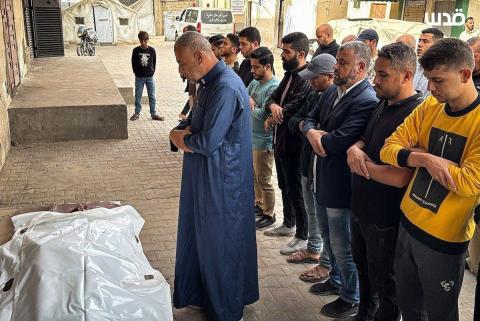
Caption: Funeral prayer for Abdulrahim Matar, killed by an Israeli airstrike in Gaza.
Daily Death Tolls:
• On October 29, 6 Palestinians were killed by Israeli fire in Gaza and 38 others were injured.
• On October 30 and 31, 2026, 6 Palestinians were killed by Israeli fire across the Gaza Strip, and 26 others were injured including two who died of earlier injuries.
• On November 1 and 2, 2026, 11 Palestinians were killed by Israeli fire across the Gaza Strip including two who were uncovered from under the rubble and 2 others were injured.
• On November 3, 2026, 6 Palestinians were killed by Israeli fire in Gaza and 27 others were injured including a Palestinian who died of earlier injuries.
• On November 4, 2026, 3 Palestinians were killed by Israeli fire including two who died of earlier injuries and 21 others were injured.
• On November 5, 2026, 5 Palestinians were injured by Israeli fire in Gaza.
• In October 2026, Israeli forces killed 143 Palestinians and injured 674 others in Gaza.
Total Death Tolls:
• Since the ceasefire agreement went into effect in Gaza on October 10, 2025, 1602 Palestinians have been killed, and 5799 have been injured, and 847 bodies have been uncovered from under the rubble of their homes.
• The number of Palestinians killed since October 7, 2023, has reached 74,618 with 175,925 injured.
• Israeli authorities have mandated a complete closure of the Rafah crossing, effectively stopping all commercial trade and humanitarian aid shipments into the region. Officials have defended this closure by pointing to allegations of smuggling activities and interference from the governing authorities in Gaza. The ramifications of this closure are expected to be significant, given that nearly 50% of all goods entering Gaza rely on the Rafah crossing. According to reports from Gaza’s Health Ministry, a staggering 42% of essential medications and 50% of all medical supplies are currently out of stock within Gaza. There is a critical shortage of diagnostic materials, and although some medications have managed to enter the territory, healthcare workers find themselves unable to effectively diagnose patients or determine the appropriate care to provide.
• Israeli military forces are continuing their westward expansion into Gaza, resulting in a shift of the established Yellow Line. In the last week alone, approximately 800 individuals have been displaced in the neighborhoods of Shuja’iya and Central Gaza as a direct consequence of this military expansion. Additionally, there have been reports indicating that the Israeli military is employing robotic technology that detonates explosives to demolish the few remaining structures located along the Yellow Line.
• The weekly update will also highlight a pressing issue in Gaza and how Palestinians in Gaza deal with it. This week the issue of electricity will be discussed.
#A few days into the genocide in Gaza, power went off and today, three years down the road, 85% of electricity networks have been destroyed.
# The total cost for damage sustained by the electricity network in Gaza is one billion$.
# Palestinians have been using solar panels to have access to the internet, speak to their families, charge their phones to run small electric devices they need. The prices of solar panels or electricity generated by them are extremely high. For instance, my family of 9 people pays 300$ a month just to be able to have basic lights, charge their laptops and phones and turn the washing machine on.
# There were attempts to turn some streets on by the Gaza Power Plant, but all initiatives don’t last long due to the lack of funding, repair, equipment and fuel.
# Bringing electricity back to parts of Gaza is possible, but it will not happen except through pressuring Israel to let repair equipment in and fuel, and for Israel to stop its airstrikes on Gaza, which is further damaging the network.