
Weekly summary of the War on Gaza, February 20, 2026
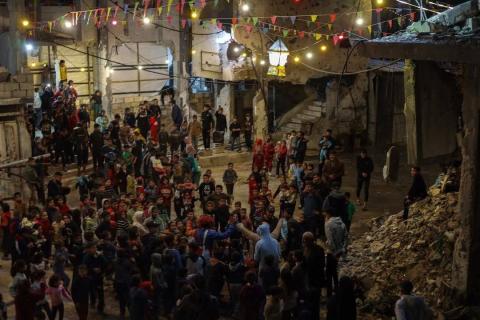
Caption: Palestinians mark the third day of the holy month of Ramadan in Gaza as they still navigate access to food.
Daily Death Tolls:
• On February 14, 2026, the bodies of 2 Palestinians arrived at Gaza’s hospitals after being uncovered from under the rubble and 15 were injured by Israeli fire and airstrikes across the Gaza Strip.
• On February 15, 2026, 10 Palestinians were killed by Israeli fire in Gaza, 9 others were injured.
• On February 16, 2026, 2 Palestinians were killed by Israeli fire in Gaza, 11 others were injured.
• On February 19, 2026, 2 Palestinians were killed by Israeli fire, and 4 others were injured.
Total Death Tolls:
• Since the ceasefire agreement went into effect in Gaza on October 10, 2025, 611 Palestinians have been killed, 1630 have been injured, and 726 bodies have been uncovered from under the rubble of their homes.
• The number of Palestinians killed since October 7, 2023, has reached 72,069 with 171,728 injured.
• A new peer-reviewed study published in The Lancet Global Health has found that the human cost of the genocide in Gaza during its first 16 months was significantly higher than earlier counts suggested. According to this population-based survey, an estimated over 75,000 people were killed violently between October 7, 2023 and January 5, 2025, a figure roughly 25,000 higher than what local health authorities reported for the same period. Researchers conducted interviews with about 2,000 households across Gaza and concluded that about 3–4 % of the territory’s pre-genocide population died as a result of direct violence, with women, children and elderly people making up a majority of the victims. The study also highlighted thousands of additional non-violent deaths linked indirectly to the conflict’s impact on living conditions and health, and noted that even the revised figures likely underestimate the full human toll.
• According to commanders of the newly announced International Stabilization Force (ISF), five countries have committed troops to serve in Gaza under this plan: Indonesia (pledging up to 8,000 personnel), Morocco, Kazakhstan, Kosovo, and Albania. In addition, Egypt and Jordan have committed to train new police forces for Gaza as part of the broader security effort. Initial deployments are expected to begin in Rafah, southern Gaza, with plans to expand across the territory as the mission develops.
• Officials tied to the newly formed Board of Peace are planning to build a military base in the southern Gaza Strip that could house about 5,000 personnel. This large compound would cover roughly 350 acres and serve as a headquarters and operational hub for the International Stabilization Force (ISF). The base is expected to include fortified structures and support facilities for the troops who will be stationed there.
• The Israeli government continues to open the Rafah crossing for limited traffic, allowing dozens of people in and out each day. As of February 18, the number of Palestinians who were able to leave Gaza reached 640 Palestinians while 508 Palestinians were able to enter Gaza through Egypt. 26 Palestinians were denied entry/exit. According to agreement with Israel, the number of Palestinians who should have left Gaza or entered should have been 3400, which means that 33% of Palestinians only were allowed to leave or enter Gaza.
• The AFSC team in Gaza organized an Iftar for Palestinians in the city of Khan Younis, which was attended by hundreds of Palestinians.